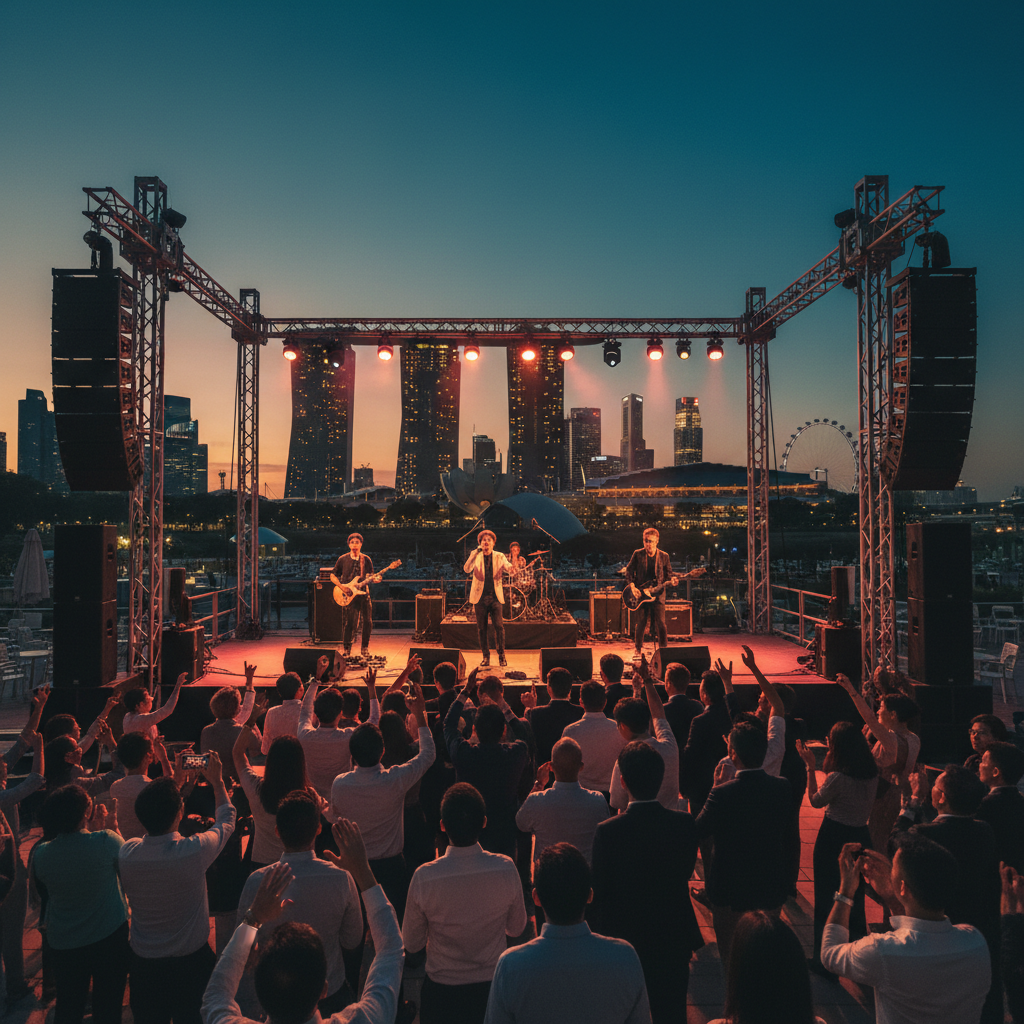
Outdoor events in Singapore, from garden weddings to large-scale brand activations at Marina Barrage, offer unique atmospheres. However, they also present specific challenges for live band sound reinforcement. Unlike indoor venues, there are no walls to contain sound, and environmental factors like wind and ambient noise play a significant role.
Choosing the correct sound system ensures your live band sounds professional and reaches every guest. This guide covers key considerations, helping you achieve optimal audio quality for your next outdoor event.
Understanding Outdoor Acoustics and Venue Types
Outdoor acoustics differ greatly from indoor settings. Sound disperses more rapidly, requiring more powerful systems to maintain clarity and volume. Consider your specific venue: a lush garden at Sentosa will require a different setup than a concrete space like the F1 Pit Building.
Factors like ground cover, nearby water bodies, and surrounding structures (or lack thereof) all impact sound reflection and absorption. A professional sound engineer will assess these details during a site visit, typically 2 to 3 weeks before your event.
Power Requirements and Generator Access
Live bands and their sound systems have substantial power needs. Outdoor venues often lack the robust power infrastructure found in hotel ballrooms. You will likely need to rent quiet, reliable generators to power amplifiers, mixers, and stage lighting.
Confirm power access with your venue manager first. If generators are needed, budget an additional SGD $300 to $800 for rental, depending on the size and duration, and ensure they are placed far enough away from the main event area to minimize noise pollution.
Speaker Systems for Open-Air Performance
For outdoor events, line array speakers are often the preferred choice. They offer excellent throw distance and controlled dispersion, ensuring sound reaches the back of a large audience without excessive volume upfront. Point source speakers can work for smaller, more intimate gatherings, but may struggle to cover larger areas adequately.
Subwoofers are essential for live bands, providing the low-end frequency response that gives music its punch. Position them strategically for even bass distribution.
Weather Protection and Backup Plans
Singapore's tropical climate means sudden downpours are always a possibility, especially during monsoon seasons (November to January). All audio equipment must be protected from rain and humidity. This includes waterproof covers, canopies, or a sturdy gazebo for the stage area.
Always have a contingency plan. This might involve an indoor backup location, or at minimum, sufficient covers to protect equipment and instruments quickly. Your audio vendor can advise on rental options for weather-resistant gear.
Microphones and Monitoring for Outdoor Stages
Wind can be a major issue for microphones outdoors. Use wind screens on all vocal and instrument microphones to reduce noise. Wireless microphones offer flexibility for performers but require careful frequency management to avoid interference.
On-stage monitoring is critical for bands to hear themselves perform. In-ear monitors (IEMs) are excellent for outdoor stages as they provide a consistent sound mix for the musicians, unaffected by ambient noise or wind. Floor monitors (wedges) are an alternative but may contribute more to overall stage volume.