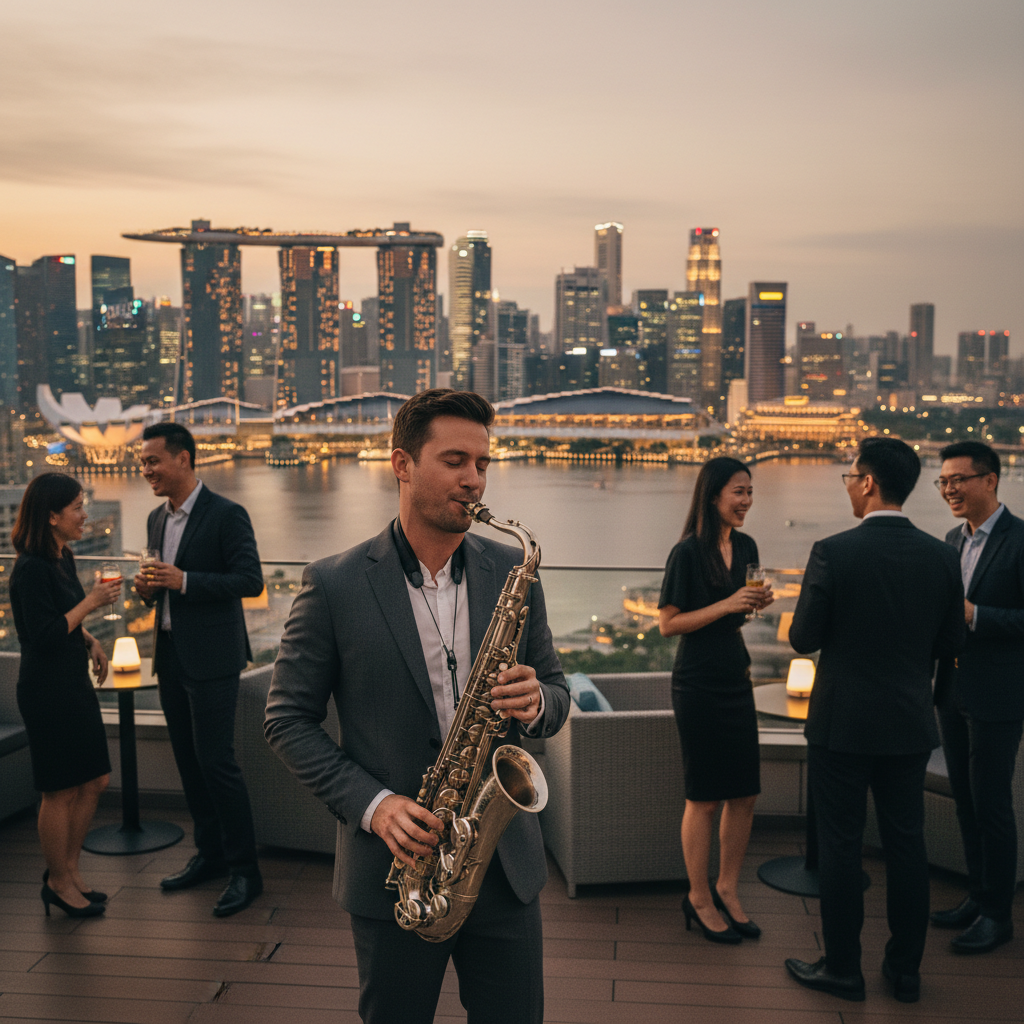
Rooftop venues across the Singapore Central Business District offer unmatched skyline views for client appreciation nights and regional summits. Locations like 1-Arden at CapitaSpring, Marina Bay rooftop terraces, and South Beach create impressive backdrops. Yet staging live entertainment dozens of floors above ground brings distinct logistical challenges.
High winds, sudden tropical rainfall, and strict National Environment Agency noise caps require careful planning before you confirm your entertainment lineup. An act that sounds effortless in an indoor ballroom can face acoustic and environmental difficulties when exposed to open-air conditions.
From selecting weather-resistant musicians to managing wireless frequencies against urban interference, here is your practical roadmap for rooftop event entertainment in Singapore.
Selecting the Best Entertainment Acts for Rooftop Patios
Compact acoustic and hybrid setups thrive on rooftop decks. Solo saxophonists, electric violinists, and acoustic duos deliver full musical presence without overwhelming limited terrace square footage. You can review our solo saxophonist roster to see how single instrumentalists cover dynamic cocktail settings.
Heavy percussion kits and large brass sections rarely suit open-air rooftops. High winds scatter acoustic sound unevenly, and the sheer volume often conflicts with nearby residential developments or hotel guest wings. By contrast, a versatile open-format DJ paired with a live saxophonist creates an energetic club lounge feel while keeping decibel levels adjustable.
Roving performers provide added value on sprawling observation terraces. A roving mentalist or acoustic player can circulate among clusters of guests, bridging the gap between indoor bar lounges and outdoor viewing railings.
Managing Weather, Wind, and Rooftop Acoustics
Wind gusts at 40 storeys often reach 25 to 35 knots, creating severe microphone distortion if audio technicians do not prepare. Ensure your sound supplier brings high-density foam windshields or faux fur covers for all vocal and instrument microphones. Sheet music will blow away immediately, so musicians should read digital charts secured with heavy tablet clamps.
High humidity and sudden afternoon squalls threaten sensitive acoustic instruments. Wooden violins, double basses, and hollow-body guitars expand and contract in humid tropical air, causing pitch slippage. Professional performers frequently use carbon fiber or solid-body electric instruments outdoors to avoid weather damage.
Always establish a mandatory wet-weather fallback plan with the venue operations team. If rain sweeps through, your production crew must be able to shift electrical components under an awning or indoors within eight minutes to prevent equipment damage and protect guest safety.
Singapore NEA Decibel Caps and Venue Curfews
The National Environment Agency enforces strict environmental noise limits on commercial outdoor venues across Singapore. Open-air entertainment must stay under 75 dBA at property boundaries during evening hours, dropping to 65 dBA after 11 PM. Venues near residential pockets in Tanjong Pagar or Robertson Quay face even stricter oversight.
To comply with limits while maintaining clear sound quality, work with an audio crew that deploys distributed audio speaker arrays. Placing four smaller speakers closer to guest seating zones delivers crisp fidelity at moderate volumes. This approach avoids blasting a single massive speaker stack toward adjacent office towers.
Schedule your entertainment blocks around venue sound curfews. Many rooftop venues require live amplified bands to stop by 10 PM or 10:30 PM, shifting to ambient background playlists for the final hour of your gathering.
Production Logistics and Building Access Rules
Transporting flight cases and sound racks up Grade A commercial office towers requires advance administrative clearance. Most building management offices at Marina Bay require security clearance forms and loading bay permits submitted at least 14 working days before event day. Crews cannot simply wheel road cases through main lobby passenger lifts during business hours.
Expect solo acts like an electric violinist or solo DJ to budget SGD 800 to SGD 1,500 for a three-hour engagement. Full acoustic trios or hybrid DJ bands generally range from SGD 2,200 to SGD 4,500. Outdoor-rated sound systems with weather-resistant cabling add an extra SGD 900 to SGD 1,800 depending on terrace dimensions.
Inspect outdoor power outlets on your initial site walk. Rooftop decks often possess limited wall sockets exposed to rain traps, requiring RCD circuit breakers and waterproof distribution boxes to prevent electrical shorting during your event.